Candles In The Dark
A Saint and a Blessed
On 25 May 1933, a young Sister of the Congregation of Our Lady of Mercy came to confess to Fr. Sopocko. He was hearing confessions in his church in Vilnius, the capital of Lithuania. After she confessed a few simple sins, she began telling him about Jesus appearing to her in a vision. She said Jesus had spoken to her about an important message He wanted to give to the world.
Taken aback, Fr. Sopocko told her he would have to speak to her superior before he could discuss this any further. He felt a kind of relief when she left. But a few weeks later, she returned to tell him that she had already seen him in a vision, even before she met him for the first time. The next thing she said startled him. That was a detail about his personal life that only God could have known.
A week later, she gave him a notebook in which she had written down what Jesus asked her to do. He took the notebook with him and a few hours later looked at it. The first thing that struck him was the bad handwriting and the many spelling mistakes. But as he kept reading, he knew that this barely literate nun had something profound to proclaim to the world – something that Jesus had revealed to her.
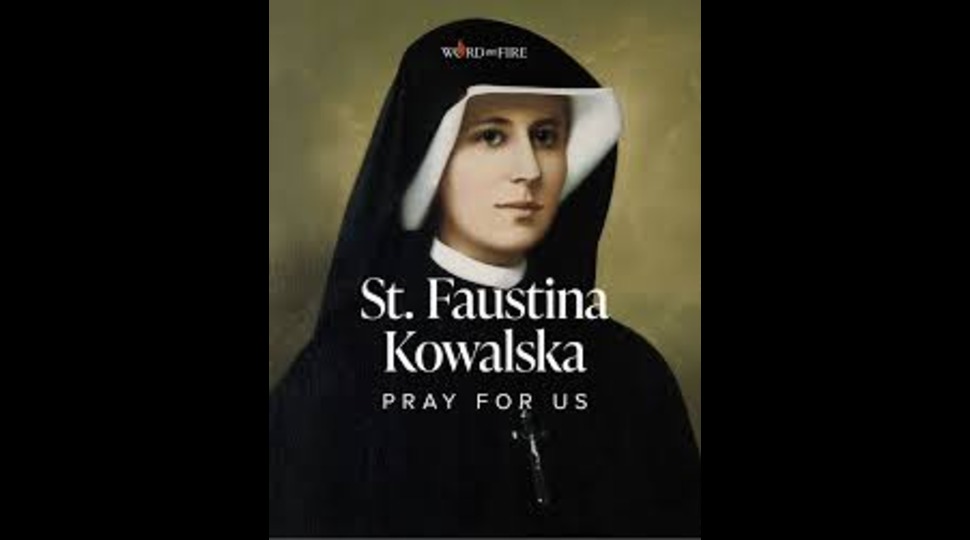
She is a saint today - St Faustina Kowalska. He is a Blessed – Bl. Michael Sopocko.
Sopocko was born to Polish parents in 1888 in Yusawshchyna near Valozhyn in the country now called Belarus. He entered the seminary in 1910 and was ordained a priest in 1914. He served as a pastor in Vilnius for four years, and as a chaplain in the army in Warsaw and Vilnius during World War I. After obtaining his doctorate in theology in 1926, he became a professor of pastoral theology at Stefan Batory University in Vilnius. He was also the spiritual director of Sr. Faustina’s congregation.
The essence of what Jesus conveyed to her is what we call the Divine Mercy. It was she who received all the revelations, but, as her spiritual director, he played a stellar role in bringing all those to the world’s attention. Speaking of him, Faustina said that Jesus told her, "He will be my visible help for you on earth. He will help you to carry out my will…His thoughts are closely united to mine… I will not let him make a mistake, and you should do nothing without his permission."
It was Fr Sopocko who persuaded Sr Faustina to write everything she saw and heard in her visions. As soon as she completed a notebook, she gave it to Fr Sopocko. These writings, recorded in six notebooks, were later published as the "Diary of Saint Faustina" (Divine Mercy in My Soul), which has now become one of the important books on Catholic mysticism.
Since Sr Faustina repeatedly affirmed that God’s greatest attribute was His mercy, Fr Sopocko studied the writings of the Fathers of the Church and theologians to see whether any of them spoke on this. “I was delighted to discover that St Fulgentius, St Alphonsus and, especially, St Thomas Aquinas and St Augustine wrote something similar. St Augustine – in his commentaries on the Psalms – discussed Divine Mercy at great length, and wrote that this is God’s greatest attribute.” This helped Fr Sopocko dispel all doubts about the nature of Sr Faustina’s revelations.
There were three more things she said Jesus wanted – a painting depicting Jesus as He appeared to her, prayers to Divine Mercy, and a feast in honour of the Divine Mercy on the Sunday after Easter.
Since Sr Faustina herself could not paint, in January 1934, Fr Sopocko had a university professor, Eugeniusz Kazimirowski, paint the image as described by Sr Faustina. Fr Sopocko himself dressed and posed for the painting. He was with Sr Faustina whenever she had to meet the artist, till the painting was completed. It was he who paid the artist. It was he who got the permission of the local Archbishop to have the image of the Divine Mercy displayed publicly for the first time.
In August 1937, Fr Sopocko found in a notebook Sr Faustina had given him the novena, the chaplet and some prayers to the Divine Mercy. When he asked her, she replied that Jesus himself had dictated them to her. On the basis of some expressions found in those prayers, Fr Sopocko composed a litany about Divine Mercy and got all the three published, after obtaining ‘Imprimatur.’
It was Fr Sopocko who wrote articles in theological magazines explaining why the feast of Divine Mercy had to be celebrated on the Sunday after Easter. After being celebrated in Poland and Lithuania, the feast was officially instituted for the universal Catholic Church in 2000 by Pope St. John Paul II.
After Sr Faustina died at the age of 33, Fr Sopocko did what she had repeatedly told him about Jesus’ desire. In 1942, he founded a new religious congregation -- the Sisters of Merciful Jesus -- to spread his message of Divine Mercy. During World War II, he was involved in a courageous enterprise -- getting persecuted Jews to a safe sanctuary. He was chased by the Gestapo, the Nazi secret police, and was jailed in the infamous prison in Vilnius. But he managed to escape after two weeks. Sometime later, when he was celebrating the Eucharist, the church was surrounded by Gestapo, but a neighbour rushed to the church and warned him. He escaped to the forest under a wagon load of hay. Divine Mercy seemed to protect him throughout his life.
The guide, chosen by God for his holiness and intellect, to direct the apostle of Divine Mercy, died on 15 February 1975 at the age of 87. Beatified by Pope Benedict XVI in 2008, he is on his way to sainthood.
Blurbs
As Fr Sopocko kept reading the notebook of Sr Faustina, he knew that this barely literate nun had something profound to proclaim to the world – something that Jesus had revealed to her.