Candles In The Dark
An Epitome of Courage
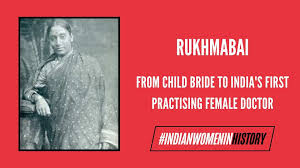
Do you know the first Indian woman doctor to practice in the country? Do you know the name of the woman who fought valiantly against the practice of child marriage, which was then widely prevalent in India? The answer for both is the same. Her name is Rukhmabai.
Rukhmabai was born to Janardhan Pandurang and Jayantibai in 1864 in Maharashtra. Her father, Janardhan, died when Rukhmabai was still a child. Her family belonged to the carpenter community where widows were allowed to remarry. Rukhmabai’s mother, Jayantibai, made a good choice. She married Sakharam Arjun, a widower, who was an eminent physician and a social activist in Mumbai.
Just two-and-a-half years after Jayantibai’s second marriage, Rukhmabai, who was just 11 years old, was married to 19-year-old Dadaji Bhikaji, a cousin of her stepfather. Traditionally, the husband would live with his own family till his child-wife came of age. But Bhikaji was allowed to stay with Rukhmabai’s family after the marriage, since they hoped that the new atmosphere at her house would make him study and complete his school education and reform his ways.
Rukhmabai attained puberty six months after her marriage and the traditional celebration of ‘Garbhandan’ was held. The celebration meant that the time for ritual consummation of marriage had come. But her stepfather, Dr Arjun, did not permit it, saying that she was still not old enough for pregnancy and childbirth. But her husband Bhikaji was not pleased. Nor did he enjoy being forced to go to school at the age of 20. So he left and, against the advice of Dr Arjun, went to live with his uncle. The atmosphere at his uncle’s house made him more indolent and wayward than before. He began to borrow money, hoping to clear his debts by selling the dowry given at the time of marriage.
But Rukhmabai shocked everyone when she refused to go and live with him at his uncle’s house, but her stepfather supported her decision. Quite unlike her wayward husband, she studied at home, using books she borrowed from the library. Since her stepfather was a social activist and reformer, she met several prominent persons who fought for social reform.
An angry Bhikaji filed a case against her, which went on for four years. Finally the court ordered her to live with her husband or face a prison term of six months. Rukhmabai chose to go to prison. Her courage to choose jail over forced cohabitation brought her a great deal of coverage in the Indian and British media and made her a living symbol of feminism. Rukhmabai wrote eloquent, passionate letters to Queen Victoria, asking her to intervene and put an end to the sufferings Indian girls and women had to undergo because of the yoke of child marriage. The case was finally settled out of court.
When her intelligence and passion to study came to be known, reformers and benefactors established a fund that allowed her to travel to the U.K. to pursue medical studies. Studying at the London School of Medicine for Women and the Royal Free Hospital, she qualified as a doctor in 1894 and returned to India.
Opting for a life of service, she worked in hospitals in Surat and Rajkot, performed complicated surgeries, and raised funds to train Indian nurses. Her courage that made her fight a heinous custom now made her a daring doctor who risked her life serving victims of plague and epidemics. Writing under the pseudonym "A Hindu Woman," Rukhmabai actively campaigned for the right of women to education, to own property and to choose the time of their marriage. Her efforts contributed to the eventual enactment of the Age of Consent Act in 1891. She established the Red Cross Society at Rajkot. Her pioneering struggles won for her the Kaisar-i-Hind medal.
Rukhmabai died on 25 September 1955 at the age of 90. Her extraordinary life has been celebrated in a book called Rukhmabai: The Life and Times of a Child Bride Turned Rebel-Doctor and a film titled Doctor Rakhmabai. A hospital in Surat was named after her. On 22 November 2017, Google commemorated Rukhmabai's 153rd birthday with a Google Doodle on their Indian front page. Indian women owe much to such stalwarts.
Blurb
Her courage to choose jail over forced cohabitation brought her a great deal of coverage in the Indian and British media and made her a living symbol of feminism.